Case study
How RSGI transformed legal research workflows with HighQ
By optimizing HighQ, RSGI streamlined research workflows, improved data quality, and unlocked deeper insights from submissions
The client
A limited global intelligence and advisory agency, RSGI Limited is behind some of the most legal prestigious benchmarks, notably the Financial Times Innovative Lawyers (FTIL) Reports and Awards. Each year, their expert team sifts through hundreds of detailed submissions nominating firms and in-house legal teams doing genuinely groundbreaking work.
Despite being a relatively small team, their research is rigorous, analytical, and trusted across the legal research and innovation community. The prestige of the FTIL Programme owes much to the care and scrutiny RSGI brings to the process.
To manage such a vast and complex review cycle, they rely on HighQ, a powerful collaboration and workflow platform from Thomson Reuters, which has become central to the research process.
RSGI instructed, a specialist legal automation consultancy, to help refine and optimise the implementation of HighQ to improve this process.
Less manual work
Streamlined research workflows
Better data quality
Standardized submission process
More time for analysis
Focus shifted to research activities
What is HighQ and how does RSGI use it?
HighQ is an advanced collaboration and project management platform that brings together secure data storage, collaboration tools, automated workflows, and dashboard-style reporting. Legal teams use it to manage everything from client portals to internal project management. But it’s more than just a file-sharing tool. It’s a fully customisable workspace that lets users automate manual steps, standardise inputs, and track data at every stage of a process.
For RSGI, HighQ is the operational engine behind the FTIL submission process. Law firms and in-house legal teams enter their submissions through a HighQ form, which feeds directly into a centralised system the researchers use to manage the entire process.
Patrick Shortall, Research and Editorial Producer at RSGI said:
"HighQ is our knowledge management system for the entire FTIL process - from the collection of submissions, to our initial assessment, to interview notes and final write-ups."
This use case is especially interesting because RSGI uses HighQ in a way that’s quite different from how it’s typically deployed in legal teams, showing just how versatile the platform can be when adapted to a unique, data-driven research workflow.
“We now have more time to focus on our assessments and analysis of innovation because the better organised information is, the more time you have to research the submissions.”
Patrick Shortall
Research and Editorial Producer, RSGI Limited
The challenge
Originally, the FTIL process was managed using Excel, which was sufficient at the time, but quickly became overwhelmed by the growing volume and complexity of submissions.
Several years ago, RSGI adopted HighQ as a centralised platform to handle submissions and store previous years’ data. It was a major improvement. HighQ helped them move away from spreadsheets and evolve their process as their research for the FTIL awards grew.
But as submission numbers increased and the research team continued to expand the scope of their work, RSGI needed to take HighQ further, to make it fit the next phase of their evolution.
Their current HighQ process across each awards cycle involved:
- Creating a new HighQ site for that year’s submissions
- Using separate sites to store reference data from previous years
- Opening submission forms via open links for law firms and legal departments
- Removing external access post-deadline and then beginning weeks of structured interviews and in-depth analysis, all of which needed to be captured and managed by the system.
The team were still handling a lot of manual support queries from submitters, cleaning up inconsistent data entries, and managing workflows that weren’t yet tailored to the way they operated day to day.
They could see HighQ’s potential, but they didn’t have the in-house expertise to unlock it. Shortall continues:
"A year ago, I found that you could create data visualisations based on the status of submissions, which gave me a much clearer view on my workload. After sharing with colleagues, we realised there's a lot more that we could do with this system."
That’s where echo.legal came in.
The solution
Using HighQ, and working with implementation partner echo.legal, RSGI was able to make its FTIL process simpler, smoother, and more powerful by designing workflows that fit how the research team works. Shortall commented:
"In a relatively short time — especially given our non-standard use of HighQ — echo.legal were able to understand our processes and what was important to us."
The echo.legal team started with a scoping session to understand RSGI’s goals, reviewing how the current process operated and what was causing friction. From there, they reshaped the platform to reduce the load on RSGI’s team, enhance the experience for users, and improve the quality and consistency of the data being collected.
Key enhancements implemented in HighQ included:
- A cleaner, more user-friendly site design. echo.legal’s experts overhauled the HighQ interface so that submitters could follow clearer instructions and submit their entries without confusion. For instance, adding simple, intuitive buttons, like “Submit here”, directly on the homepage eliminated the need for users to hunt for links or ask for help.
- Standardised data capture. Redesigned submission forms to reduce manual cleanup, ensuring every entry was structured for downstream analysis. This dramatically improved reporting quality and saved time.
- Smarter workflows. echo.legal built workflows to automatically track where each submission was in the process — initial review, interview completed, final write-up pending, and so on. The system allows researchers to add as much or as little detail as they need, while still giving project leads clear visibility into progress.
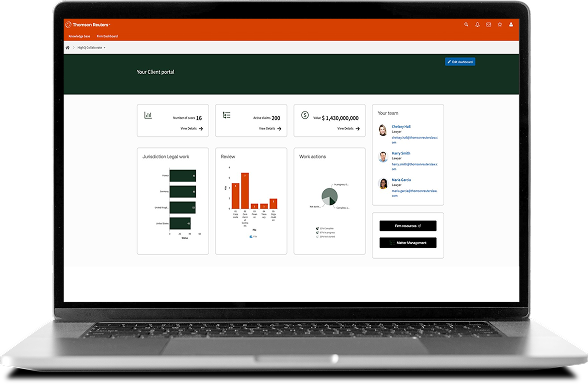
- Clearer visuals and dashboards. HighQ’s customisable dashboards gave the team a visual overview of outstanding tasks, bottlenecks, and metrics such as the number of submissions, how many are in each phase, and who’s assigned to what.
- Risk reduction. By reducing manual steps and standardising data flows, the system is easier to manage and helps minimise the potential for user error.
- Boilerplate custom code. echo.legal also provided reusable snippets of code to make future implementations easier and faster.
HighQ is a highly flexible and powerful solution, and a key outcome of the engagement was helping RSGI fully leverage HighQ’s flexibility — adding buttons, data fields, or logic flows exactly where needed to support their workflow.
Implementation
Echo.legal’s Chief Innovation Officer Julie Saliba and legal technologist and integrations specialist Josh Kowszar led the project, which ran during May and June. By mapping the current processes and showing how it could be improved, echo.legal’s specialists helped RSGI see the value of the changes immediately. Their work didn’t just mechanically improve the system, it helped RSGI better understand how their own workflow could evolve. The “submit” button on the homepage for example, was a small change, but a practical example of how incremental improvements can have a significant impact on usability and efficiency. Shortall commented:
“What echo.legal did that was great is they kind of took a look at the system and presented it back to us. And then it made us kind of understand what actually our process is.”
The implementation then followed a phased approach. Changes were introduced in real time so that RSGI could test, adapt, and see immediate improvements before each next stage of development. This flexible rollout meant the team could get value from the system right away, while also leaving room for echo.legal to return with additional refinements and support as the project matured.
The results
The new system has already had a significant impact on the FTIL process, and it continues to evolve.
“Allowing the care we take in research to shine through is what's really important to us, and we’re excited to take that to the next level.”
- More time for real research. With a smoother submission experience and clearer internal workflows, the team spends less time box-ticking and manually following up on queries, and more time doing the careful, expert-led analysis that makes their work so respected.
- Deeper insight with less effort. Because submissions are now captured in a structured format, RSGI can see patterns at a glance — trends over time, how firms have evolved, who’s been consistently improving.
- Granular but flexible workflows. Researchers can mark submissions at whichever level of detail is relevant. That granularity is translated into smart summaries via workflow automation. This helps project leads understand exactly where things are without chasing updates.
- More accurate and complete data. The redesigned submission form captures better metadata from the start, including how many submissions came in, who submitted them, and what topics are trending, which makes long-term analysis much easier.
At a glance
Industry
Legal research and advisory services
HQ region
London, England
Solutions
HighQ
Year founded
2001
See how HighQ transforms legal operations
Discover how Thomson Reuters HighQ helps legal teams centralize work, automate processes, and gain visibility with data‑driven insights across the business.