Highlights
- Shadow AI use in high-stakes bids can expose companies to criminal and civil liability under evolving UK law.
- Senior manager attribution reforms from June 2026 broaden corporate exposure to all criminal offences, not just economic crimes.
- Proper AI governance and clear policies are essential to mitigate risks of fraud, misuse, and employment disputes.
This is the third in our series where we are using Westlaw Advantage to ask difficult legal questions about AI, as part of the work Hogan Lovells Cadwalader is doing with Thomson Reuters. The analysis in this blog is based on that Westlaw Advantage research, with follow-up insights from Hogan Lovells Cadwalader lawyers.
In the first article, we looked at where responsibility might sit in the AI supply chain when AI output causes loss. In the second, we looked at AI-enabled cyber threats and the legal response when a business is on the receiving end of an AI-assisted attack.
This time, the question sits inside the business: what happens when someone in your team uses an AI tool in a way the company has not approved?
This is a live issue for many businesses, who are not simply allowing AI use; many are actively encouraging it. Teams are being pushed to use AI to work faster, gather intelligence and improve commercial outputs. At the same time, control over actual usage can be uneven. Employees may use approved tools. They may also use tools outside the approved environment — often described as “shadow AI”. Even within approved tools, users may push systems harder than expected, using long prompts, document retrieval, large-context workflows and ‘token-maxing’ to extract more value.
Used properly, AI can be a powerful tool. But in a high-pressure commercial setting, particularly where bonuses, deadlines and competitive tenders are involved, AI can also make it easier for employees to cross lines quickly.
This is about more than whether the employee has breached an AI policy. The question we are looking at is whether such conduct creates exposure for the company.
This is important because the UK corporate criminal liability landscape is changing. The failure to prevent fraud offence is now in force, after the introduction of the senior manager attribution model for economic crimes in December 2023. From 29 June 2026, the position changed again, with the senior manager attribution model extending more broadly to all criminal offences.
Jump to ↓
Hogan Lovells Cadwalader insights
The scenario
In the factual scenario we put to Westlaw Advantage, a UK company is bidding for a major contract. Senior leadership is encouraging AI use to improve productivity and win work, but the company policy says employees must use only approved enterprise AI tools.
A senior business development lead is responsible for the bid. Their bonus depends heavily on winning the contract. Instead of using the approved enterprise tool, they use a personal AI tool with browsing and document retrieval functionality.
The tool is used to search the customer’s procurement portal and related web material. It finds and summarises documents that appear to be confidential tender material: draft scoring criteria, internal customer comments, competitor Q&A and pricing sensitivity documents. The material may have been exposed through a misconfigured portal, an unlinked URL, old credentials or credentials granted for a different purpose.
The employee realises, or strongly suspects, that the material was not intended for bidders. They use it anyway. The AI tool helps them tailor the bid, draft internal approval notes that omit the source of the intelligence, and prepare tender certifications stating that the company has complied with procurement rules and has not improperly obtained or used confidential information. The company wins the contract.
The scenario is fictional, but it is exactly the kind of problem that can arise where AI adoption, commercial pressure and weak controls meet.
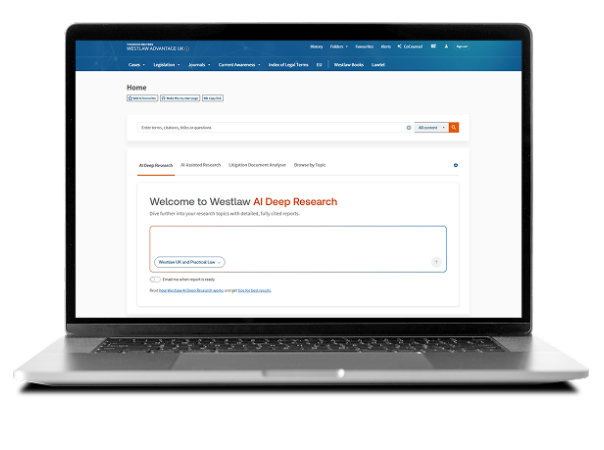
How we used Westlaw Advantage
This was a useful example of using Westlaw Advantage iteratively.
In other LLM tools, the process can feel more like a free-flowing conversation: ask a broad question, brainstorm, redirect, test scenarios and refine. Westlaw AI works differently. The better approach is to ask one detailed, structured question and then use targeted follow-ups to test the pressure points.
The initial response gave a strong research map, covering legal issues as wide ranging as fraud, computer misuse, corporate attribution, failure to prevent fraud, civil claims, procurement law consequences, and employment law issues. The follow-ups were then enormously helpful to delve into more detail on those issues.
AI-assisted criminality
Fraud is one route into corporate exposure. If a tender submission includes certifications that the bidder has complied with procurement rules, has not improperly obtained confidential information, and has not used competitor or customer material inappropriately, those certifications may become false or misleading if the bid has in fact been shaped using material that should never have been accessed.
Fraud Act offences are already within the senior manager attribution regime for listed economic crimes. If a senior manager commits the relevant fraud offence while acting within the actual or apparent scope of their authority, the company may itself be liable. There is no reasonable procedures defence.
The failure to prevent fraud offence may also be engaged. If an associated person commits a relevant fraud offence intending to benefit the organisation, a large organisation may be liable unless it can show that it had reasonable fraud prevention procedures in place.
In the bid context, those two routes can sit alongside each other.
The first research answer dealt with the law as it then stood. The follow-up question therefore asked directly what changes after 29 June 2026. The answer drew the important distinction. Under ECCTA section 196, senior manager attribution applied only to listed economic crimes committed by senior managers.
From 29 June 2026, the position changed materially. Section 250 of the Crime and Policing Act 2026 extends senior manager attribution to all criminal offences. On that basis, a Computer Misuse Act offence committed by a senior manager may be attributed to the company if the senior manager was acting within the actual or apparent scope of their authority.
The company would not have authorised the senior employee to access confidential tender material improperly. But that is not a complete answer. If the employee’s role included leading bids, gathering market intelligence, dealing with procurement portals, preparing submissions and making tender representations, then they could have been acting within the apparent scope of their authority. The focus is likely to be on the function they were performing, not simply whether the company approved the misconduct.
For the purposes of the Computer Misuse Act, the key question is whether the employee knowingly accessed data they were not authorised to see. A genuinely public webpage may be different from an unlinked URL, a misconfigured procurement portal, old credentials that still work, or credentials granted for one purpose but used for another. The employee’s state of mind will matter. If they concealed the source of the material internally and then signed clean tender certifications, that may support the inference that they understood the material was not properly available for use.
Civil consequences may also follow. A tainted bid may give rise to claims for breach of confidence, misuse of confidential information, misrepresentation, breach of tender conditions and breach of contractual warranties.
There is also an employment law issue. A senior employee might fairly be dismissed for using a non-approved tool in this way, particularly where confidential material was knowingly exploited and the source concealed.
Hogan Lovells Cadwalader insights
Claire Lipworth, Liam Naidoo and Olga Tocewicz are part of Hogan Lovells Cadwalader’s disputes practice and specialise in business crime and corporate investigations.
 Olga notes: “Attribution and failure to prevent fraud are different routes to corporate exposure. A company may face direct liability for a senior manager’s fraud, while the failure to prevent offence asks whether reasonable procedures were in place to stop associated persons committing fraud for the organisation’s benefit.”
 Claire adds that “the attribution reform was passed without much fanfare, and there remains a real question about who will prosecute these cases in practice. But the risk is not academic: from 29 June, senior manager attribution potentially brings a much wider range of offences into corporate criminal exposure.”
 Liam flags that “the civil law consequences may arrive before any prosecution. A tainted bid can quickly become an injunction, delivery-up, termination, rescission or damages issue, particularly where a customer or competitor says the tender process was distorted.”
Stefan Martin is a Partner in Hogan Lovells Cadwalader’s Employment practice. He notes: “any dismissal decision would turn on the facts: the employer’s policy and how it brought this to employees’ attention, any training provided, the employee’s seniority, how the tool was used, including the exploitation of confidential information, whether senior employees turned a blind eye to or encouraged system use outside the scope of the policy, any attempt by the employee to cover up their actions, and whether the employer followed a fair process.”
He added: “Policies, including disciplinary procedures, should make it clear that using AI systems in a way that is outside the scope of what is permitted, or using non-approved systems, is a serious matter that will result in disciplinary action up to and including dismissal.”
What you need to know
This example looks at one aspect of corporate criminal liability, but the wider lesson is that approved or non-approved AI use can put a company on the hook for wrongdoing through several routes.
As a research exercise, this was also a useful example of how Westlaw Advantage can support an analysis of a factual scenario giving rise to a range of different legal issues. The initial question produced a detailed research map. The follow-ups then tested the issues in detail.
The answer is that fraud exposure is already part of the landscape. Failure to prevent fraud adds a separate risk for large organisations. Civil claims may arise if confidential material has been misused or a tender process has been distorted.
But the 29 June 2026 attribution reform raises the stakes. Senior manager attribution now extends to all criminal offences. In this scenario, that means Computer Misuse Act offending by a senior employee may give rise to criminal liability for the business, with potentially unlimited fines.
That is not an academic risk. It gives prosecutors another route to consider where serious misconduct has taken place inside a company, even if the company did not expressly authorise the offending. It is also a reform that many businesses may not yet have focused on. The change has received relatively limited attention, but it may leave companies exposed to a wider range of criminal offences on the statute book.
The AI scenario illustrates the point neatly. A business may think it is managing an AI governance issue, an employee misconduct issue or a procurement issue. In the right case, it may also be managing a corporate criminal liability issue.
Reuben Vandercruyssen is a Senior Associate in Hogan Lovells Cadwalader’s disputes practice, advising on complex litigation, investigations and business crime. He has a particular focus on AI and emerging contentious risk, including liability and governance issues arising from generative AI.
